
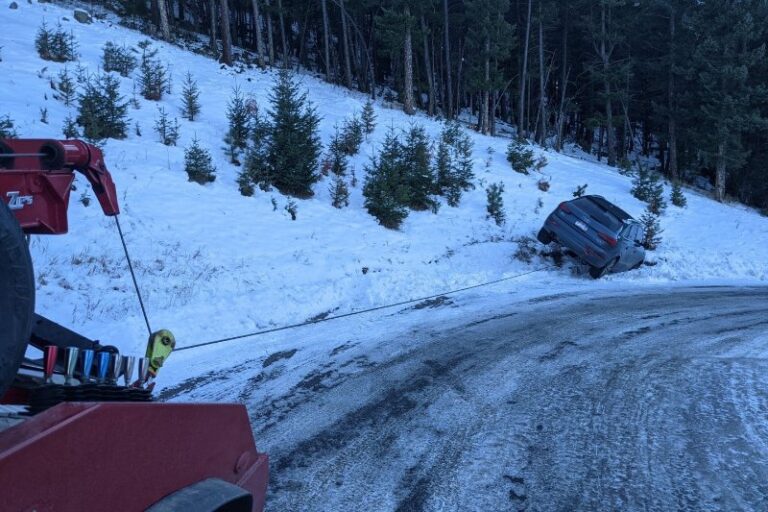
Late fall is when my phone starts ringing with a certain kind of call. A hunter’s truck slid off a forest road above Conifer. A delivery van tried a steep driveway on Lookout Mountain after a dusting of snow and ended up sideways. Somebody followed their GPS down a road that turned out to be more of a suggestion. None of these folks need a tow in the usual sense. They need to be pulled out, set back on solid ground, and pointed home. That is what a winch-out, or off-road recovery, is for.
What a winch-out actually is
A winch-out is when we use the winch on our truck to pull a vehicle that is stuck or off the road back onto a surface where it can drive again. Think mud, snow, a ditch, a soft shoulder, or a driveway that turned into a sled run. If the vehicle runs fine and nothing is broken, a winch-out often ends with you driving away on your own.
A tow is different. If the vehicle is damaged, will not start, or is not safe to drive after it comes out, we load it and take it where it needs to go. Plenty of calls are both. We winch it out first, look it over, and then decide together whether it rides home on the flatbed or drives.
Why foothills recoveries are their own animal
Pulling a car out of a flat parking lot ditch is one thing. Up here the ground is rarely flat. You have grades, loose gravel over rock, drop-offs on the downhill side, and narrow roads where the wrecker cannot line up straight with the stuck vehicle. The angle of the pull matters, the anchor point matters, and the order you do things in matters. Get it wrong and a stuck car becomes a rolled car.
That is why we run four-wheel-drive wreckers and why our operators are WreckMaster trained. That training is about exactly this: rigging, angles, load, and getting a vehicle out without bending anything that was not already bent. We would rather take an extra ten minutes setting up than make your bad day worse.
What to do the moment you get stuck
First, stop spinning the tires. I know the urge. But every extra spin digs the tires deeper, polishes snow into ice, and on a slope it can walk the vehicle sideways toward the edge. If you are not out after a gentle try or two, you are probably not getting out on your own.
Second, think about safety before anything else. If you are on or near a road, turn on your hazards. If anyone is hurt, or you are blocking traffic on a highway, call 911 first. If the vehicle is leaning or sitting on a steep side slope, get everyone out on the uphill side and stand well clear.
Third, figure out exactly where you are. In town that is easy. On forest roads it is not. Drop a pin on your phone while you still have signal, note any road number or mile marker, and look for landmarks. The more precisely you can describe your location, the faster we find you.
A word about tow straps and well-meaning friends
I am all for neighbors helping neighbors, but a lot of the recoveries that go badly start with a strap and a buddy’s pickup. Straps hooked to a trailer ball, a bumper, or a suspension part can let go under load, and when they do, the hardware becomes a projectile. If someone does try to pull you out, use proper rated recovery points on both vehicles, keep everyone far out of line with the strap, and stop if it is not working. When in doubt, call a pro.
What to tell us when you call
When you call 303-588-6025, these details help us show up with the right truck and the right plan: where you are, as exactly as you can say it; what you are driving and whether it is two-wheel or four-wheel drive; how it is stuck, whether in mud, snow, a ditch, or off the edge; whether it still runs and whether anything looks damaged; and how many people are with you and whether anyone is hurt.
If you are somewhere we cannot safely get a truck to, I will tell you straight and help you figure out your next step. That honesty is part of the job.
Common foothills recovery calls
Most of what we see falls into a few buckets. Vehicles that slid off a snowy grade or driveway. Trucks and SUVs bogged down on muddy forest roads during hunting season or spring melt. Cars that dropped a wheel off a soft shoulder on a narrow road. Vehicles that went into a ditch after a skid on ice. And the occasional heavier load, like a trailer or camper that got wedged on a tight turn. Each one gets rigged differently, which is why we ask so many questions on the phone.
A few ways to avoid the call
Good tires with real tread make the biggest difference, and in winter they are often the law on mountain highways. If you have not read it yet, our guide to Colorado’s traction law and chain law covers what your tires need. Beyond that, turn around early when a road looks worse than your vehicle can handle, carry a shovel and traction mats in winter, keep your fuel above half, and let someone know where you are headed when you go up into the forest.
If you are still not sure what kind of truck your situation calls for, our article on light-duty versus medium-duty towing explains the difference.
When you need us
If you are stuck, off the road, or in a ditch anywhere around Evergreen, Conifer, Kittredge, Idledale, Morrison, or up toward Idaho Springs, give us a call. You can read more about our accident and winch recovery service, and if it turns out the vehicle needs to ride on a truck after it comes out, our towing and recovery crew takes it from there. Fair price, no games, and a careful pull.
Brian Rothlisberger
Owner, Bear Creek Towing
