
When your car breaks down on the side of the road or you need to transport a vehicle, calling for a tow truck seems straightforward enough. But here’s where things get tricky: not all towing services are created equal. The difference between light-duty and medium-duty towing can mean the difference between a smooth, damage-free transport and a costly mistake.
At Bear Creek Towing, we’ve been handling towing and recovery in Colorado’s mountain communities since 2012, and one of the most common questions we get is, “What kind of tow truck do I actually need?” It’s a fair question, and an important one. Let’s break down exactly what separates these two towing categories so you can make an well-informed choice when you’re stuck on the roadside or planning a vehicle transport.
What Is Light-Duty Towing?
Light-duty towing is the most common type of towing service on the road today. It covers the vehicles most of us drive every day, sedans, coupes, small SUVs, crossovers, and compact trucks. Basically, if you’re driving a standard passenger vehicle, light-duty towing is what you need.
Light-duty tow trucks typically handle vehicles weighing up to 10,000 pounds gross vehicle weight rating (GVWR). This includes the vast majority of personal vehicles on American roads. Think Honda Accords, Ford F-150s, Toyota RAV4s, and even most full-size SUVs like the Chevrolet Tahoe.
At Bear Creek Towing, light-duty towing is our specialty. We operate a fleet of four-wheel drive Dodge Ram 5500 wreckers and flatbeds, equipment specifically designed to handle passenger vehicles safely and efficiently. Our flatbed trucks are particularly valuable for damage-free towing, which matters a lot when you’re dealing with exotic cars, classic vehicles, or motorcycles.
Light-duty services typically include:
- Standard roadside breakdowns
- Accident recovery for passenger vehicles
- Winch-outs from snow, mud, or ditches
- Motorcycle and small trailer transport
- Insurance and motor club tows
If you drive a typical car, truck, or SUV, light-duty towing will cover your needs in almost every situation.
What Is Medium-Duty Towing?
Medium-duty towing steps up when vehicles get heavier and larger. We’re talking about box trucks, delivery vehicles, small buses, RVs, larger work trucks, and commercial vehicles that exceed what light-duty equipment can safely handle.
Medium-duty tow trucks handle vehicles with a GVWR typically ranging from 10,000 to 26,000 pounds. That’s a significant jump from light-duty capacity and requires more powerful equipment, different towing techniques, and specialized training.
Vehicles commonly requiring medium-duty towing include:
- Box trucks and delivery vans
- Large pickup trucks with heavy loads
- Small to mid-size RVs and campers
- Shuttle buses and passenger vans
- Commercial work trucks
- Fifth wheel trailers and gooseneck trailers
- Tiny houses and small sheds
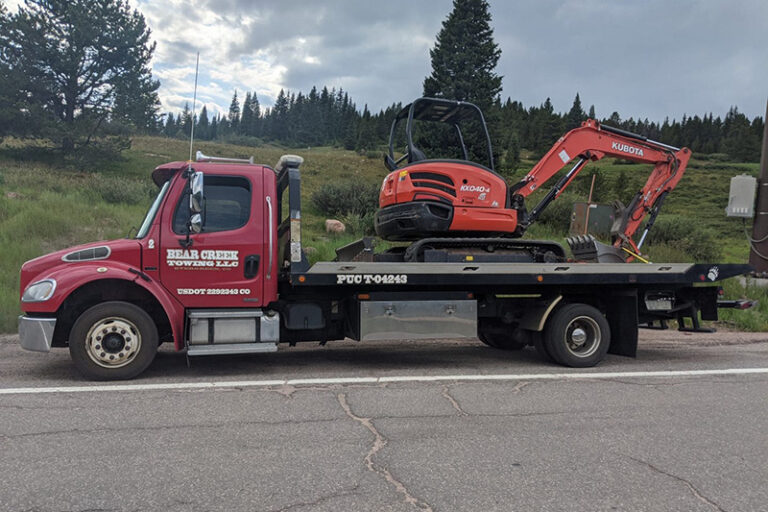
We operate a medium-duty Freightliner flatbed at Bear Creek Towing specifically for these larger jobs. This truck gives us the power and capacity to safely transport heavier vehicles and equipment that would overwhelm our light-duty fleet.
Medium-duty towing also requires operators with additional training and experience. The physics of moving a 20,000-pound vehicle are completely different from towing a 4,000-pound sedan, and mistakes can be dangerous, and expensive.
Key Differences Between Light-Duty and Medium-Duty Towing
Understanding the practical differences between these two towing categories helps you communicate better with your towing provider and ensures you get the right service for your situation.
Weight Capacity and Vehicle Types
The most fundamental difference comes down to weight. Light-duty towing maxes out around 10,000 pounds GVWR, while medium-duty handles vehicles from 10,000 to roughly 26,000 pounds.
But weight isn’t the only factor. Vehicle dimensions matter too. A long cargo van might weigh less than 10,000 pounds but still require medium-duty equipment because of its size and shape. Similarly, the way weight is distributed affects towing requirements, a heavily loaded work truck with equipment in the bed presents different challenges than an empty pickup of the same model.
Here’s a quick reference:
| Category | Weight Range | Common Vehicles |
|---|---|---|
| Light-Duty | Up to 10,000 lbs | Sedans, SUVs, pickups, motorcycles |
| Medium-Duty | 10,000–26,000 lbs | Box trucks, RVs, buses, commercial vehicles |
Equipment and Tow Trucks Used
Light-duty tow trucks come in several configurations. Wheel-lift trucks hook under the vehicle’s wheels and lift one end off the ground. Flatbed trucks (also called rollbacks) carry the entire vehicle on a tilting bed, this is what we use for exotic cars, classics, and any situation where keeping all four wheels off the ground matters.
Medium-duty trucks are built on heavier chassis with more powerful winches, stronger hydraulics, and reinforced frames. Our Freightliner flatbed, for example, has the engine power and structural capacity to safely load and transport vehicles that would stress or damage our light-duty Dodge Ram trucks.
The boom and winch systems differ substantially too. Medium-duty winches can pull significantly more weight, which becomes essential during recovery operations involving heavier vehicles stuck in difficult positions.
How to Determine Which Towing Service You Need
So how do you figure out what you actually need when you’re calling for a tow? Start with these questions:
What’s the vehicle’s GVWR? You can find this on a sticker inside the driver’s door jamb. It tells you the maximum loaded weight the vehicle is designed to carry. If it’s under 10,000 pounds, light-duty towing should work. Above that, you’re looking at medium-duty.
What type of vehicle is it? Personal cars, trucks, and SUVs almost always fall into light-duty territory. Box trucks, large RVs, and commercial vehicles typically need medium-duty service.
Is the vehicle loaded? An empty Ford F-350 might be fine for light-duty towing, but that same truck loaded with landscaping equipment could push into medium-duty territory.
What’s the situation? Recovery from a steep embankment or deep mud might require more powerful equipment regardless of vehicle size.
When you call us at Bear Creek Towing, we’ll ask these questions to dispatch the right truck. Our WreckMaster-trained and certified operators know how to assess situations quickly, especially important in our steep mountain environment around Evergreen, Conifer, and the surrounding Jefferson, Clear Creek, and Gilpin county areas.
Honestly, when in doubt, just describe your vehicle and situation to the dispatcher. A good towing company would rather send the right equipment the first time than have to call for backup because the initial truck couldn’t handle the job.
Conclusion
The difference between light-duty and medium-duty towing eventually comes down to weight, vehicle type, and the equipment needed to do the job safely. Most personal vehicles fall into the light-duty category, while larger commercial vehicles, RVs, and heavy-duty trucks require medium-duty service.
At Bear Creek Towing, we’ve got both covered with our fleet of Dodge Ram 5500 wreckers and our medium-duty Freightliner flatbed. If you’re ever stuck on the roadside, whether you’re driving a compact car or a loaded box truck, we’re here to get you back on the road with damage-free towing and the professional service our family business has been known for since 2012.
