
Picture this: you’re driving along Highway 285 near Conifer when your car suddenly sputters to a stop. Maybe you’ve slid off an icy road, or your engine decided today was the day it’d give up. Now you’re stranded on the side of a mountain road, phone in hand, wondering which tow truck company to call.
In moments like these, making the right choice matters more than you might think. Not all tow companies are created equal, especially in Colorado’s mountain communities where steep grades, unpredictable weather, and remote stretches of road create unique challenges. The wrong call could mean hours of waiting, unexpected charges, or worse, damage to your vehicle.
We’ve been serving drivers in Conifer and the surrounding mountain towns since 2012, and we’ve seen firsthand what happens when people choose tow services based solely on who answers first. This guide will walk you through everything you need to know to make an well-informed choice before you ever find yourself stranded.
Why Your Choice of Tow Truck Company Matters
Let’s be honest, when your car breaks down, your first instinct is probably to call whoever can get there fastest. But taking a few extra minutes to choose wisely can save you significant headaches down the road.
First, there’s the matter of vehicle safety. An inexperienced tow operator can cause transmission damage, scratch your paint, or improperly secure your vehicle during transport. We’ve seen cars arrive at shops with bent frames or damaged undercarriages because a careless operator used the wrong equipment or technique. For owners of exotic cars, classics, or even just well-maintained daily drivers, this kind of damage is heartbreaking, and often expensive to repair.
Then there’s the financial aspect. Unscrupulous tow companies are known for hidden fees, predatory pricing, or “gotcha” charges that only appear after your car is already on the flatbed. Mountain communities like Conifer can be especially vulnerable to this because options seem limited and people feel pressured to accept whatever help arrives first.
Beyond the immediate concerns, the tow company you choose also affects how smoothly the rest of your day, or week, goes. A reliable company will coordinate with your insurance, communicate clearly about timing and costs, and treat you like a neighbor in need rather than just another transaction. Working with companies that partner with insurance providers and motor clubs can streamline the entire process, reducing paperwork and out-of-pocket expenses.
In short, the tow truck company you call sets the tone for everything that follows. Choose well, and a stressful situation becomes manageable. Choose poorly, and you’ve just added problems to your problem.
Key Factors to Evaluate Before Calling a Tow Service
Before you find yourself in an emergency situation, it’s worth knowing what separates a quality tow truck company from a subpar one. Here’s what to look for.
Licensing and Insurance Requirements
This might not be the most exciting factor, but it’s arguably the most important. Any legitimate tow company should be fully licensed and insured. In Colorado, tow operators are required to carry specific insurance coverage to protect both their business and your vehicle.
Why does this matter? If an uninsured or underinsured company damages your car during towing, you could be left footing the bill for repairs. Proper insurance ensures that if something goes wrong, a strap breaks, your car slips, whatever, you’re protected.
Beyond basic licensing, look for operators with professional certifications. WreckMaster training, for instance, is an industry-recognized certification program that ensures operators know proper techniques for vehicle recovery, damage-free towing, and safe handling of various vehicle types. When drivers have this kind of training, you can trust they won’t approach your stranded SUV like it’s their first day on the job.
Response Times and Availability
Breakdowns don’t wait for convenient hours. Your car is just as likely to die at 2 a.m. on a Sunday as it is at noon on Tuesday. That’s why 24/7 availability matters, genuinely matters, not just “we list 24/7 on our website but take an hour to answer after midnight.”
Response times also vary significantly depending on how well a company knows the local area. A tow service based three counties away might technically serve Conifer, but they’ll take much longer to reach you than a company already embedded in the mountain communities. Local operators know the shortcuts, understand which roads are likely to be icy or closed, and can navigate to remote locations without GPS leading them astray.
For areas like Clear Creek, Jefferson, and Gilpin counties, you want a company whose drivers have genuine experience in these specific mountain environments.
Pricing Transparency and Payment Options
Here’s where things can get frustrating fast. Some tow companies quote one price over the phone and present a much higher bill when the work is done. Others tack on fuel surcharges, after-hours fees, or mileage charges that weren’t disclosed upfront.
A reputable company will give you a clear estimate before dispatching a truck. They should be willing to explain their pricing structure, including any potential additional costs for things like winch recovery or difficult terrain. If a company won’t give you a straight answer about what you’ll pay, that’s a red flag.
Payment flexibility matters too. Companies that work with insurance providers and motor clubs can often bill directly, saving you from fronting large amounts of cash during an already expensive situation. Ask about payment options before you commit.
Questions to Ask When Contacting a Tow Truck Company
When you call a tow service, you’re not just requesting help, you’re interviewing a company to handle your vehicle. Having the right questions ready can help you quickly separate reliable operators from those you’d rather avoid.
“What’s your estimated arrival time?” This tells you whether they’re being realistic. A company that promises 10 minutes when they’re clearly 45 minutes away is either lying to get your business or doesn’t actually know where you are. Honest operators will give you a reasonable timeframe based on current conditions and distance.
“Can you give me a total cost estimate, including all fees?” Push for specifics here. Ask whether there are charges for mileage, after-hours service, winch use, or anything else. If they hesitate or get vague, consider that a warning sign.
“What type of equipment will you use for my vehicle?” This matters more than most people realize. Different vehicles require different towing methods. A flatbed is generally safer for all-wheel-drive vehicles, low-clearance sports cars, and classics. If the dispatcher doesn’t ask about your vehicle type before answering this question, they might not be paying attention to important details.
“Are your operators certified or trained?” Professional training programs teach proper techniques for damage-free towing and recovery. Certified operators know how to handle everything from a stuck sedan to an exotic car without causing additional problems.
“Do you work with my insurance company or motor club?” This can significantly simplify the billing process. Companies experienced with insurance claims know what documentation is needed and can help coordinate coverage directly.
“How long have you been operating in this area?” Local experience isn’t just about navigation, it’s about understanding the specific challenges of mountain roads, knowing which routes are passable in bad weather, and having established relationships within the community.
How to Verify a Company’s Reputation
Asking questions directly is valuable, but companies can tell you whatever they think you want to hear. Independent verification gives you a clearer picture of what to actually expect.
Online reviews are an obvious starting point, but read them critically. A company with 500 five-star reviews and nothing lower might have cherry-picked their feedback. Look for patterns in negative reviews, if multiple people mention hidden fees or long wait times, that’s telling you something. Also pay attention to how companies respond to complaints. A defensive or dismissive response suggests how they might treat you if something goes wrong.
Better Business Bureau ratings can reveal complaint histories and how companies resolve disputes. While not every legitimate business is BBB-accredited, a pattern of unresolved complaints is a red flag worth noting.
Word of mouth still carries weight, especially in tight-knit mountain communities like Conifer, Golden, Morrison, Kittredge, and Idledale. Ask neighbors, local mechanics, or community social media groups who they’d recommend, and who they’d avoid. People who’ve actually used a service recently can give you insights no online review captures.
Verify credentials independently. If a company claims to be licensed and insured, you can confirm this through state databases or by asking for proof. Legitimate businesses won’t hesitate to provide this information. Professional certifications like WreckMaster training can also be verified.
Look at their equipment. A company’s fleet tells you something about their professionalism. Well-maintained trucks, modern equipment, and vehicles suited to mountain terrain (like four-wheel-drive wreckers and flatbeds) indicate a company that takes their work seriously. A sketchy-looking rig should give you pause.
Special Considerations for Towing in Mountain Communities
Towing in Conifer and the surrounding mountain towns isn’t the same as towing in downtown Denver. The unique geography, weather, and road conditions of the Colorado foothills create challenges that not every tow company is equipped to handle.
Steep grades and switchbacks require specific skills and equipment. Recovering a vehicle that’s slid off a winding mountain road is fundamentally different from pulling a car out of a flat parking lot. Operators need winching expertise and the right equipment to safely extract vehicles from ditches, embankments, and snowbanks without causing additional damage, or putting themselves at risk.
Altitude and weather play significant roles. Snow, ice, and sudden weather changes are facts of life in mountain communities. A tow company’s fleet should include four-wheel-drive vehicles capable of reaching stranded motorists even when conditions deteriorate. Operators should also understand how altitude affects vehicle performance and recovery operations.
Remote locations mean longer response times for companies that aren’t locally based. When you’re broken down on a stretch of road with limited cell service, you need a company that can actually find you, and reach you, without getting lost or delayed. Local operators who serve Clear Creek, Jefferson, and Gilpin counties regularly know these roads intimately.
Vehicle variety in mountain communities tends toward trucks, SUVs, and all-wheel-drive vehicles, but plenty of residents also own sports cars, motorcycles, boats, trailers, and RVs. A versatile tow company should be able to handle everything from a stuck sedan to fifth-wheel trailer transport. Specialized equipment for exotic and classic car transport is also valuable, damage-free flatbed towing protects vehicles that can’t be traditionally towed without risking mechanical problems.
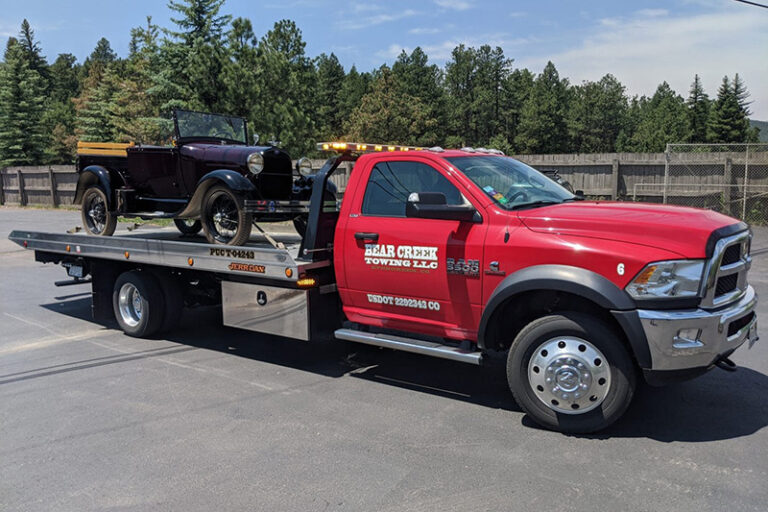
At Bear Creek Towing, our operators have more than a decade of experience navigating these exact challenges. Our fleet includes four-wheel-drive Dodge Ram 5500 wreckers, flatbeds, and a medium-duty Freightliner specifically because we know what mountain towing demands.
What to Do While Waiting for Your Tow Truck
Once you’ve called a reputable tow company, there are steps you can take to stay safe and make the recovery process smoother.
Get to safety first. If your vehicle is drivable, move it as far off the road as possible. If it’s not, turn on your hazard lights and get yourself out of the vehicle if you’re in a dangerous position, like on a blind curve or narrow shoulder. Standing well away from traffic is always smarter than staying inside a disabled car on a busy road.
Make your vehicle visible. Use hazard lights, flares, or emergency triangles if you have them. In mountain areas where visibility can be limited by curves or weather, anything that makes approaching drivers aware of your stopped vehicle helps prevent secondary accidents.
Document the situation. Take photos of your vehicle’s position, any damage, and the surrounding conditions. This documentation can be valuable for insurance claims and helps the tow operator understand what they’re dealing with before they arrive.
Stay warm and hydrated. Colorado mountain weather can turn cold quickly, even in months you wouldn’t expect. Keep an emergency kit in your vehicle with blankets, water, snacks, and a flashlight. If it’s winter, run your engine periodically to stay warm, but make sure your exhaust pipe isn’t blocked by snow.
Don’t try to fix dangerous situations yourself. If your vehicle is stuck in snow, mud, or a ditch, spinning your wheels can cause serious transmission damage and dig you in deeper. And attempting to push a vehicle on a steep mountain road can lead to injuries or make the situation worse. Wait for professional help.
Communicate with your tow company. If your situation changes, traffic picks up, weather worsens, or you notice something new about your vehicle, let the dispatcher know. Good communication helps operators arrive prepared.
Conclusion
Choosing the right tow truck company isn’t something most people think about until they’re standing on the side of the road in a stressful situation. But a little preparation goes a long way.
The key factors worth remembering: verify licensing and insurance, prioritize companies with professional training and proper certifications, demand pricing transparency, and, especially in mountain communities like Conifer, choose operators with genuine local experience and appropriate equipment.
At Bear Creek Towing, we’ve built our family-owned business on exactly these principles since 2012. Our WreckMaster-certified operators, four-wheel-drive fleet, and deep familiarity with Clear Creek, Jefferson, and Gilpin counties mean we’re equipped to handle whatever situation you find yourself in, whether that’s a flat tire in Morrison, an accident recovery near Kittredge, or specialized transport for your classic car.
We understand there’s nothing worse than needing wrecker service. That’s why we focus on making a bad day a little less painful with courteous drivers, reliable equipment, competitive rates, and damage-free towing you can count on. When you need help on the road, you deserve a tow company that treats you like a neighbor, because in our mountain communities, that’s exactly what you are.
Save our number before you need it. We’re here when you do.
