
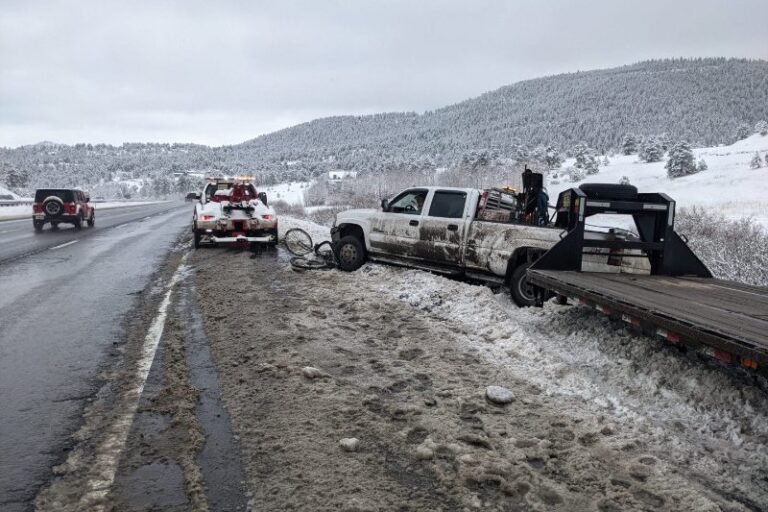
Every fall I get the same questions from folks in Evergreen and Conifer, and from plenty of people just passing through on I-70. Do I need chains? Is my all-wheel drive enough? What happens if I get pulled over? Colorado has two winter rules for passenger vehicles, the Traction Law and the Chain Law, and the details matter more than most people think. I spend a good part of every winter pulling cars out of the snow, and a lot of those calls trace back to one of these rules.
The short version
When the Traction Law is active, your vehicle needs tires with at least 3/16 of an inch of tread that are rated for winter, all-weather, or mud and snow, or you need chains or an approved traction device on your tires. When the Chain Law is active, every passenger vehicle needs chains or an approved traction device, period. The Chain Law is the last step before the highway gets shut down.
On the I-70 Mountain Corridor between Dotsero and Morrison, the Traction Law season runs every year from September 1 through May 31. CDOT can also put it into effect on other state highways when the weather calls for it, which around here can mean roads like US 285 past Conifer or Highway 74 through Evergreen.
What the Traction Law actually requires
When CDOT turns the Traction Law on, you are legal if your vehicle meets one of these: tires with at least 3/16 inch of tread that carry a mountain-snowflake symbol, an all-weather rating, or an M+S (mud and snow) marking, or chains or an approved alternative traction device, like an AutoSock, on two or more of your drive tires.
For years a lot of people believed four-wheel drive alone got them off the hook. That was never a great bet, and the 2026 update to the law (House Bill 26-1237, signed in May) made it clear the tire and tread rules apply to two-wheel-drive vehicles too. Four-wheel drive helps you get going. It does very little to help you stop or turn on ice, and it does nothing for bald tires.
That 3/16 of an inch is the part people miss. Brand new tires usually have a lot more than that, but a set of all-seasons that has seen a couple of years of Front Range driving can get close fast. A cheap tread depth gauge from any auto parts store will tell you in ten seconds. If you are near the line, you are not going to like the way that car handles on Floyd Hill in a storm, legal or not.
What the Chain Law requires
The Chain Law is the serious one. CDOT uses it during the worst storms, as the final safety step before closing a highway. When it is in effect, every passenger vehicle needs chains or an approved alternative traction device, no matter what tires you have or what drives the wheels.
If you are commuting up and down I-70 or US 285 through the winter, keep a set of chains or traction socks that fit your tires in the car, and put them on once in your driveway before you ever need them. Trying to figure out chains for the first time on the shoulder, in the dark, with trucks going by, is not where you want to learn.
How you know when the laws are in effect
CDOT posts it on the overhead and roadside signs along the highway, on COtrip.org, and through their text and email alerts. If you drive the mountains regularly, sign up for those alerts. Checking COtrip before you leave the house takes a minute and can save you a long afternoon.
What happens if you are not compliant
Colorado can fine drivers who are not compliant when the Traction or Chain Law is active, and the penalty goes up considerably if your vehicle ends up blocking a travel lane. The exact amounts have changed over the years, so check CDOT’s Traction and Chain Law page for the current figures rather than going by what a neighbor told you.
To be honest, the ticket is the small problem. The big problem is the spun-out car that closes a lane for an hour, backs up traffic for miles, and turns into a tow that could have been avoided with the right tires.
Why this matters so much up here
I have been pulling vehicles off these roads since Bear Creek Towing started in 2012, and my dad was doing it for decades before that. Most of the winter calls we get are not because somebody was reckless. They are good drivers on tired tires, or rental cars from out of state on summer rubber, or someone who figured the storm would hold off another hour. The mountain grades around Evergreen, Kittredge, and Idledale do not give you much room to recover once the tires let go.
A few habits go a long way. Check your tread every fall. Keep the tank at least half full in winter so a closure does not leave you running on fumes. Keep a blanket, water, a phone charger, and a small shovel in the car. Our article on getting your vehicle ready for snowy mountain roads covers the rest, and cold mornings are hard on batteries, so take a look at how to protect your car battery in cold weather too.
If you slide off anyway
It happens to careful people. If you end up in a ditch or stuck on a grade, stay in your vehicle if it is safe, turn on your hazards, and call 911 first if anyone is hurt or you are blocking traffic. Then give us a call at 303-588-6025.
Please do not keep spinning the tires trying to power out. That usually digs you in deeper, and on a slope it can slide the vehicle further toward the edge. We run four-wheel-drive wreckers and flatbeds built for this terrain, and our operators are WreckMaster trained, so we can winch you back onto the road without adding damage. You can read more about how we handle accident and winch recovery, and if all you need is a tire change, a jump, or some fuel to get moving, our roadside services cover that.
Our posted hours are weekday mornings through early evening and Saturdays, but winter does not keep business hours, and I answer the phone after hours when I can. If you are not sure whether you need a tow or just a pull back onto the road, call and ask. It costs you nothing to find out.
A quick checklist before the next storm
Check your tread depth and make sure it is at least 3/16 of an inch. Look for the mountain-snowflake, all-weather, or M+S marking on your tires. Put chains or traction socks that fit your tires in the car, and practice putting them on once. Sign up for CDOT alerts and check COtrip.org before heading up I-70 or US 285. And save our number in your phone, just in case.
Stay safe out there this winter.
Brian Rothlisberger
Owner, Bear Creek Towing
